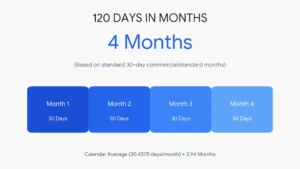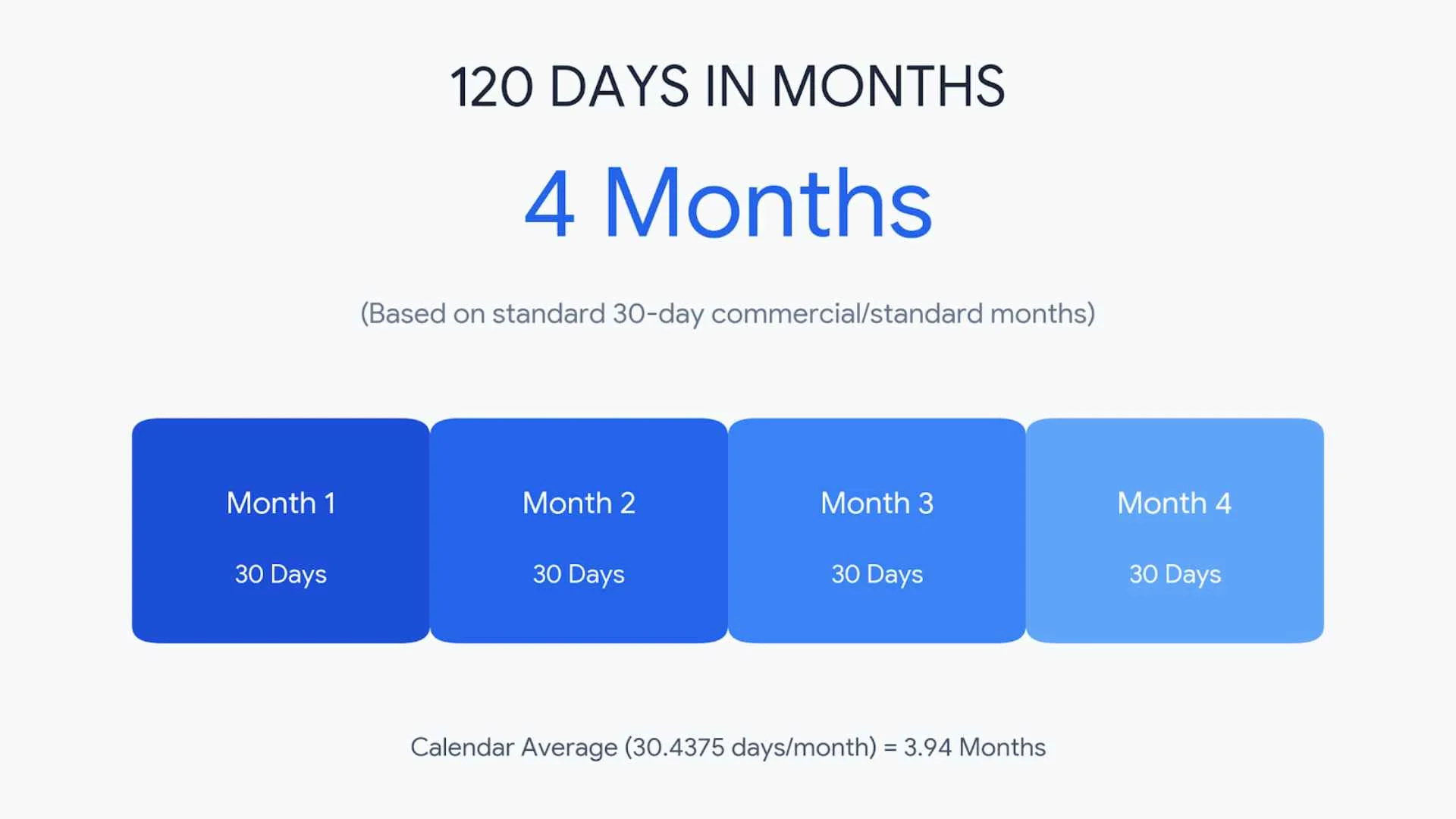
If you are asking how many months is 120 days, the most useful answer is approximately 3.94 months, or about 4 months.
For a quick calculation, many people use 30 days as one month:
120 ÷ 30 = 4 months
However, a calendar month is not always 30 days. Months can have 28, 29, 30, or 31 days. Because of this, 120 days is not always exactly the same as four calendar months.
The difference matters when you are calculating a deadline, waiting period, contract, challenge, course, application, or an exact date. This guide explains both the simple conversion and the more accurate calendar method.
How Many Months Is 120 Days?
120 days is approximately 3.94 months.
If you need a simple everyday answer, you can round that to:
120 days ≈ 4 months
The exact result depends on which definition of a “month” you use.
| Conversion | Result |
| 120 days using a 30-day month | 4 months |
| 120 days using the average month | About 3.94 months |
| 120 days in weeks | About 17.14 weeks |
| 120 days in hours | 2,880 hours |
| 120 days in minutes | 172,800 minutes |
| 120 days in seconds | 10,368,000 seconds |
So, if someone simply asks “120 days is how many months?”, the best short response is:
120 days is about 4 months, or approximately 3.94 months using the average calendar month.
How to Convert 120 Days to Months
There are two common ways to convert days into months.
Using a 30-Day Month
The easiest method is to assume that one month contains 30 days.
The formula is:
Months = Days ÷ 30
For 120 days:
120 ÷ 30 = 4
Therefore:
120 days = 4 months when using a 30-day month for the calculation.
This method is convenient because it is easy to understand and calculate mentally.
However, it is an approximation. Real calendar months do not all contain 30 days.
Using the Average Length of a Month
For a more precise general conversion, you can use the average length of a Gregorian calendar month, which is approximately 30.44 days.
The calculation becomes:
120 ÷ 30.44 ≈ 3.94 months
Therefore:
120 days ≈ 3.94 months
This is the better answer when you want a mathematical conversion rather than a simple rounded estimate.
Which Calculation Should You Use?
It depends on what you are trying to find.
Use 4 months when you need a quick, everyday estimate.
Use 3.94 months when you want a more precise mathematical conversion.
Use calendar counting when you need to know an exact date.
That last point is particularly important. If a contract says “120 days,” you should not automatically replace it with “4 months,” because the two periods can end on different dates.
Is 120 Days Exactly 4 Months?
No, not necessarily.
It is exactly four months only when you define each month as 30 days.
Actual calendar months have different lengths. For example:
- Some months have 31 days.
- Some have 30 days.
- February has 28 days in a normal year.
- February has 29 days in a leap year.
Because of this, four consecutive calendar months may contain more or fewer than 120 days.
For example, a four-month period could contain 120, 121, 122, 123, or 124 days, depending on the months involved.
This is why the phrase “120 days equals 4 months” is useful as a quick estimate but should not be treated as an exact calendar rule.
Why Calendar Months Make the Answer Different
The main reason is simple: a month does not have a fixed number of days.
A day always has 24 hours, and a week always has seven days. A month is different because its length depends on the calendar.
For example:
| Month | Days |
| January | 31 |
| February | 28 or 29 |
| March | 31 |
| April | 30 |
| May | 31 |
| June | 30 |
| July | 31 |
| August | 31 |
| September | 30 |
| October | 31 |
| November | 30 |
| December | 31 |
This variation means you cannot always take a starting date, add four calendar months, and assume exactly 120 days have passed.
120 Days Compared With 4 Calendar Months
It helps to separate these two ideas.
120 days is a fixed number of days.
4 months is a calendar-based period whose length depends on the months involved.
For example, if a four-month period includes two 31-day months and two 30-day months, it contains:
31 + 30 + 31 + 30 = 122 days
That is already two days longer than 120 days.
Another combination can produce a different total.
Therefore, if accuracy matters, always check whether the instruction refers to 120 days or four calendar months.
What Is 120 Days in Weeks?
One week contains seven days.
To convert 120 days into weeks:
120 ÷ 7 = 17.14 weeks
So, 120 days is approximately:
17 weeks and 1 day
This can be useful when you are tracking a long-term schedule, challenge, study plan, training period, or other weekly routine.
What Is 120 Days in Hours?
There are 24 hours in one day.
So:
120 × 24 = 2,880 hours
Therefore:
120 days = 2,880 hours
This is an exact conversion because every standard day contains 24 hours.
What Is 120 Days in Minutes?
There are 1,440 minutes in one day.
Therefore:
120 × 1,440 = 172,800 minutes
So:
120 days = 172,800 minutes
What Is 120 Days in Seconds?
One day contains 86,400 seconds.
The calculation is:
120 × 86,400 = 10,368,000 seconds
Therefore:
120 days = 10,368,000 seconds
These smaller-unit conversions are exact, unlike the month conversion, because days, hours, minutes, and seconds have fixed relationships.
120 Days From a Specific Date
Sometimes people searching “how many months is 120 days” are actually trying to find out what date falls 120 days after a particular date.
In that situation, simply adding four months is not always accurate.
Instead, count 120 actual calendar days from the starting date.
For example, if a period begins on a particular date, the final date depends on how many days occur in each month during that period.
Why the Starting Date Matters
Suppose a 120-day period starts near the beginning of a month. The end date can be different from a 120-day period that starts near the end of the same month.
This is because the calculation moves through months with different lengths.
Therefore, when someone asks:
“What date is 120 days from my start date?”
the correct approach is to calculate the actual number of calendar days rather than simply adding four months.
120 Days Before a Specific Date
The same principle applies when counting backward.
If you want to know what date was 120 days before a particular date, count backward by 120 calendar days.
Do not automatically subtract four months.
The two calculations can produce different dates because calendar months have different lengths.
This distinction can be important for deadlines, records, applications, agreements, and other situations where the exact date matters.
What Does a 120-Day Period Mean in Real Life?
A period of 120 days can represent roughly four months, so it appears in many everyday situations.
Someone might be tracking:
- A 120-day fitness challenge
- A study or training program
- A work probation period
- A contract period
- An application waiting period
- A project timeline
- A personal goal
- A subscription or service period
- A business deadline
- A scheduled review period
In casual conversation, calling 120 days “about four months” is usually fine.
For an official deadline, however, you should follow the exact wording. If the requirement says 120 days, count 120 days. If it says four months, use the calendar-month definition provided by the relevant organization or agreement.
120 Days vs. 4 Months: What Is the Difference?
The difference can be summarized simply:
| 120 Days | 4 Months |
| Fixed number of days | Calendar-based period |
| Always 120 days | Length varies |
| About 3.94 average months | Can be around 120–124 days |
| Useful for exact day-based periods | Useful for calendar scheduling |
This is why 120 days and four months can be close without being identical.
How Many Months Are 90, 120, and 180 Days?
Comparing nearby numbers can make the conversion easier to understand.
| Number of Days | Approximate Months |
| 30 days | 0.99 month |
| 60 days | 1.97 months |
| 90 days | 2.96 months |
| 120 days | 3.94 months |
| 150 days | 4.93 months |
| 180 days | 5.91 months |
| 210 days | 6.90 months |
| 240 days | 7.88 months |
| 270 days | 8.87 months |
| 300 days | 9.86 months |
| 365 days | About 12 months |
These values use an average month of roughly 30.44 days, so they should be treated as conversions rather than exact calendar periods.
How Many Days Are in 4 Months?
There is no single number of days that applies to every four-month period.
Four months can have different totals depending on the months included.
For example:
30 + 31 + 30 + 31 = 122 days
Another combination could produce a different total.
February can make the difference even more noticeable because it contains either 28 or 29 days.
So, if someone asks “How many days are in four months?”, the safest answer is:
It depends on which four calendar months you mean.
For a general estimate, four months is about 121–122 days, while 120 days is approximately 3.94 average months.
Is 120 Days a Long Time?
For many everyday purposes, 120 days is roughly four months, which is long enough to see meaningful changes in a project, habit, course, fitness plan, or personal goal.
Four months can feel relatively short for a long-term goal but significant for something that requires regular progress.
For example, a 120-day plan gives you approximately:
17 weeks
That can be useful for breaking a larger goal into weekly milestones.
Instead of viewing the entire period as one block, you could divide it into smaller stages:
- Days 1–30: Start and build consistency.
- Days 31–60: Continue and improve.
- Days 61–90: Review progress.
- Days 91–120: Finish the final stage.
This is one reason people often describe a 120-day period as a four-month plan.
Common Questions About 120 Days
How many months is 120 days exactly?
Using the average Gregorian month length, 120 days is approximately 3.94 months. For a simple estimate, it is commonly rounded to 4 months.
Is 120 days the same as 4 months?
Not always. If you use 30 days as one month, then 120 days equals four months. But four actual calendar months can contain a different number of days.
How many weeks are in 120 days?
120 days equals approximately 17.14 weeks, which is 17 weeks and 1 day.
How many days are in 4 months?
It depends on the four months. Because months have different lengths, four calendar months do not always contain exactly 120 days.
How do you calculate days into months?
For a general mathematical conversion, divide the number of days by the average number of days in a month:
Months ≈ Days ÷ 30.44
For 120 days:
120 ÷ 30.44 ≈ 3.94 months
Is 120 days longer than 3 months?
Yes. Three calendar months are generally around 90–92 days, while 120 days is about four months.
Is 120 days longer than 4 months?
It can be. It depends on the specific four calendar months being compared. A four-month period can contain more than 120 days.
How many months is 120 business days?
120 business days is very different from 120 calendar days because weekends and possibly public holidays are excluded. The exact number of calendar months depends on the workweek, holidays, and starting date.
What is 120 days from today?
To find the exact date, start with today’s date and count forward 120 calendar days. Do not simply add four months if you need an exact result.
What is 120 days before a date?
Count backward by 120 calendar days from the date in question. This may produce a different result from subtracting four calendar months.
Final Answer: How Many Months Is 120 Days?
So, how many months is 120 days?
The most accurate general conversion is:
120 days ≈ 3.94 months
For a simple everyday calculation:
120 days ≈ 4 months
The important difference is that 120 days is a fixed period, while four months is a calendar period. Since calendar months have different numbers of days, they are not always exactly equal.
If you only need a quick answer, remember:
120 days is about 4 months, or approximately 3.94 months based on the average month length.
For deadlines and exact dates, always calculate the actual 120-day period on the calendar rather than assuming it is exactly four months.

Lily Anderson
Hi, I’m Lily Anderson, a passionate writer who believes in the power of prayers and positivity. Ever since I was young, I’ve found comfort and inspiration in sharing stories that uplift the soul. Writing has always been my way of connecting with people, spreading hope, and exploring the deeper meaning of life. I love exploring the intersection of faith, daily life, and personal growth through my words. Every story I write comes from the heart, and I hope it touches yours too. When I’m not writing, you can find me journaling or meditating on new ideas for prayers.
Books:
-
Whispers of Hope
-
Daily Blessings: A Prayer Journal