Have you ever opened a long post online, scrolled through endless paragraphs, and wished someone would just give you the main point? If so, you’ve already experienced the reason why “TL;DR” became so popular.
This small internet abbreviation appears everywhere—from social media posts and Reddit discussions to work emails and online articles. Yet many people still wonder what it actually means and when they should use it.
Understanding internet slang helps you communicate better online and stay connected with modern digital culture. Based on years of observing online communities and social media trends, TL;DR remains one of the most widely used abbreviations on the internet.
What Does TL;DR Mean?
TL;DR stands for “Too Long; Didn’t Read.” It is an internet abbreviation used when a piece of text is very long. People use it to either say they did not read the entire content or to provide a short summary of a lengthy article, post, email, or discussion.
Today, TL;DR is most commonly used before a brief summary that highlights the main points of longer content.
Meaning & Definition
The primary meaning of TL;DR is:
Too Long; Didn’t Read
It originally expressed that a message, article, or post was too lengthy for someone to read completely.
Over time, the meaning evolved. Now, people often use TL;DR to introduce a summary at the end of long content.
Example 1
Person A: I wrote a 2,000-word explanation about the project.
Person B: TL;DR please?
Meaning: “Can you give me the short version?”
Example 2
Post: Here’s my detailed travel story from Europe…
TL;DR: Missed my flight but had an amazing trip.
Meaning: A quick summary of the entire story.
What does TL;DR mean on chatgpt
TL;DR means “Too Long; Didn’t Read.” On ChatGPT, people often use it when they want a short summary of a long answer, article, message, or discussion. It tells the reader to focus on the main point without going through every detail.
For example, after receiving a long explanation, someone might ask, “TL;DR?” They usually want the key answer in a few clear sentences. A useful TL;DR should keep the main idea, important result, or practical takeaway while leaving out minor details.
What does TLDR mean in business
In business, TLDR means “Too Long; Didn’t Read.” People use it to give a quick summary of a report, meeting discussion, proposal, email, or project update.
For example, a long project update might end with a TLDR that says the team finished the first stage, found one issue, and needs approval before moving forward. This helps busy readers understand the outcome quickly.
The term usually works best in informal workplace communication. For formal reports, phrases such as “Executive Summary” or “Summary” may sound more professional.
What does TLDR mean in a relationship
In a relationship, TLDR means “Too Long; Didn’t Read,” but people often use it casually when discussing a long message or emotional situation.
Someone might send a detailed story about an argument and then add a TLDR that explains the main situation in one or two sentences. For example, the short version could explain that two people had a misunderstanding and need to talk calmly.
Because relationship conversations can involve feelings and sensitive details, a TLDR can help someone understand the basic situation, but it may leave out emotional context that matters.
What does TLDR mean in email
In email, TLDR means “Too Long; Didn’t Read.” People commonly place it near the beginning or end of a long email to provide the main point quickly.
For example, an email may explain several project details and then include a short TLDR such as: “TLDR: The deadline moved to Friday, and we need the final files by Thursday.”
A good email summary should answer the most important question first. Keep it short, specific, and easy to scan.
How to use TL;DR
Use TL;DR when you want to give readers a quick version of a longer message or explanation. You can place it before the summary or after the full content.
Common formats include:
- TL;DR: The meeting starts at 10 AM instead of 11 AM.
- TL;DR: We approved the new plan and will begin next week.
- TL;DR: The main issue comes from a missing setting.
- TL;DR: I agree with the idea, but we need more time.
Use TL;DR mainly in casual or informal communication. In a formal document, Summary, Key Takeaway, or Executive Summary may fit better.
What does TLDR mean in tech
In tech, TLDR means “Too Long; Didn’t Read.” Developers, technical writers, and online communities use it to summarize technical information that may take time to understand.
A technical post might explain a software problem, several possible fixes, and the final solution. The TLDR can give readers the answer immediately while the rest of the content provides the technical details.
For example, a developer could write: “TLDR: Update the package and restart the application.” Readers who need the reasoning can continue reading the full explanation.
What does tldr mean in gaming
In gaming, tldr means “Too Long; Didn’t Read.” Players use it when they want a quick version of a long guide, strategy discussion, patch explanation, or game-related post.
For example, a player may explain a complicated strategy and then add a TLDR that says which weapon, character, or tactic they recommend. This gives other players the main idea without making them read the entire discussion.
Gamers also use the term casually in chats, forums, Discord conversations, and community discussions.
TLDR Reddit meaning
On Reddit, TLDR means “Too Long; Didn’t Read.” Reddit users often add it to long posts so readers can understand the main point quickly.
A TLDR can summarize a personal story, debate, question, technical explanation, review, or discussion. For example, a long Reddit post might describe a problem in several paragraphs and then end with a short summary explaining what happened and what the writer wants to know.
The term does not mean that the full post has no value. It simply gives readers a faster way to understand the central idea.
Background & Origin
TL;DR originated in early internet forums and online discussion boards during the late 1990s and early 2000s.
As online communities grew, users often encountered extremely long posts. Many readers would respond with “TL;DR” to indicate that the content was too lengthy to read.
Eventually, writers began adding their own TL;DR sections at the end of posts to help readers quickly understand the main idea.
The abbreviation became especially popular on Reddit, forums, blogs, and social media platforms.
Why People Use It
- Saves time
- Highlights key information
- Improves readability
- Helps readers understand long content quickly
- Fits modern fast-scrolling internet behavior
Usage in Different Contexts
Casual Chats
Friends often use TL;DR when someone sends a long message.
Example:
“I just got a five-paragraph text from my cousin. TL;DR: He’s moving to another city.”
Social Media
Content creators use TL;DR summaries to increase engagement.
Example:
“TL;DR: Here’s everything you need to know about the update.”
Professional Use
In workplaces, TL;DR sections can summarize reports or emails.
Example:
“TL;DR: The project is on schedule and under budget.”
Gaming & Group Chats
Gamers frequently use TL;DR to summarize strategies, updates, or discussions.
Example:
“TL;DR: Attack the left side first and save resources for the final round.”
Meanings Across Platforms
| Platform | Tone | Example |
| Casual | TL;DR: I’ll arrive at 7 PM | |
| Informal | TL;DR: Here’s what happened today | |
| TikTok | Trendy | TL;DR: This trend is worth trying |
| Snapchat | Friendly | TL;DR: It was a crazy day |
| Discord | Community-Based | TL;DR: New game update drops tomorrow |
Real-Life Examples & Memes
Chat Example
Friend: I wrote a huge review about the movie.
You: TL;DR?
Friend: Great visuals, weak ending.
Social Media Example
“Just read a 20-page report.”
“TL;DR: Everything costs more now.”
Meme-Style Examples
- “Wrote a novel in the group chat. Nobody read it. TL;DR.”
- “My life story? TL;DR: Coffee and chaos.”
These humorous uses are common across social media and meme culture.
Cultural or Regional Interpretations
United States & United Kingdom
TL;DR is widely recognized and commonly used in online discussions, blogs, and social media posts.
Asia (India, Pakistan, Philippines)
Young internet users frequently use TL;DR in English-language chats, educational groups, and social media communities.
Australia
Australians use TL;DR similarly to users in the US and UK, especially in online forums and social platforms.
Other Meanings
| Field | Meaning | Description |
| Internet Slang | Too Long; Didn’t Read | Most common meaning |
| Online Writing | Summary Section | Brief recap of long content |
| Content Marketing | Reader-Friendly Summary | Helps improve readability |
| Digital Communication | Quick Takeaway | Main point of a discussion |
Common Mistakes & Misconceptions
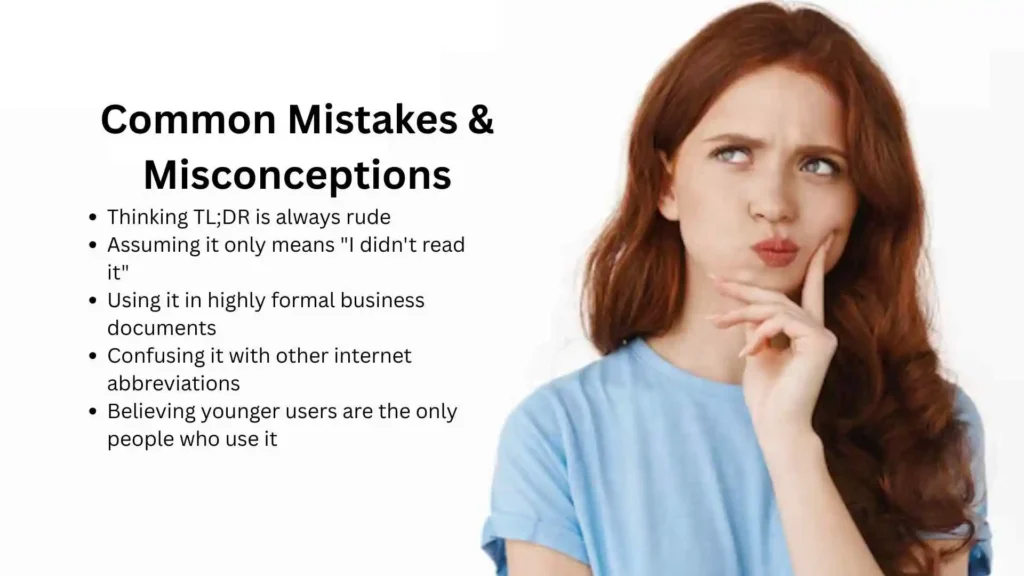
- Thinking TL;DR is always rude
- Assuming it only means “I didn’t read it”
- Using it in highly formal business documents
- Confusing it with other internet abbreviations
- Believing younger users are the only people who use it
Psychological / Emotional Meaning
The tone of TL;DR depends on context.
Positive
Used helpfully to provide a summary.
Example:
“TL;DR: The meeting went well.”
Neutral
Simply offers a shorter version.
Example:
“TL;DR: We agreed on the plan.”
Negative
Can sometimes sound dismissive.
Example:
“TL;DR. Nobody wants to read all that.”
In this context, it may appear sarcastic or critical.
Similar Terms & Alternatives
| Word | Meaning | Tone |
| Summary | Brief overview | Professional |
| In Short | Quick explanation | Neutral |
| Long Story Short | Condensed version | Friendly |
| Briefly | Short explanation | Formal |
| Bottom Line | Main takeaway | Professional |
Is It Offensive or Friendly?
TL;DR is generally friendly and harmless.
However, context matters.
Friendly Example
“TL;DR: We had a great vacation.”
Potentially Rude Example
“TL;DR. Nobody cares.”
The second example may sound dismissive or insulting.
Grammar or Linguistic Insight
TL;DR is an example of how language evolves online.
Like LOL, BRB, and IMO, it began as internet shorthand but eventually became part of everyday digital communication.
Today, many people use TL;DR even in professional environments because it efficiently communicates a summary.
How to Respond
Here are natural responses when someone uses TL;DR:
- “Thanks for the summary.”
- “That makes sense.”
- “Can you explain a little more?”
- “Got it, thanks.”
- “That’s all I needed to know.”
Differences From Similar Words
| Term | Meaning | Difference From TL;DR |
| Summary | Short version | More formal |
| Abstract | Academic overview | Used in research |
| Recap | Review of events | Often chronological |
| Overview | General explanation | Broader than TL;DR |
| Bottom Line | Final takeaway | Focuses on conclusion |
Relevance in Dating & Online Culture
TL;DR has become common in modern dating and online interactions.
On apps like Tinder, users often joke about long bios by saying “TL;DR.”
Gen Z users especially appreciate quick communication and concise information.
Examples include:
- Dating profile summaries
- Relationship advice posts
- Social media story recaps
- Group chat updates
The term aligns perfectly with today’s fast-paced online culture.
Popularity & Trends
TL;DR remains highly popular across:
- TikTok
- Discord
- YouTube comments
- Online forums
As attention spans become shorter and content becomes longer, TL;DR continues to grow in relevance.
Many creators now intentionally include TL;DR sections to improve user experience and engagement.
When NOT to Use TL;DR
There are situations where TL;DR may not be appropriate.
Formal Business Letters
Avoid using internet slang in official correspondence.
Academic Papers
Use “summary” or “abstract” instead.
Legal Documents
Professional terminology is more appropriate.
Serious Conversations
Using TL;DR may appear insensitive during emotional discussions.
Job Applications
Formal language is usually the better choice.
FAQs
What does TL;DR stand for?
TL;DR stands for “Too Long; Didn’t Read.” It is commonly used online to summarize lengthy content or indicate that something is very long.
Is TL;DR rude?
Not usually. It is often used helpfully as a summary. However, it can sound rude if used to dismiss someone’s message.
Where did TL;DR come from?
The abbreviation originated on internet forums and discussion boards during the early days of online communities.
Can I use TL;DR in work emails?
Yes, in many modern workplaces. It is often used to provide a quick summary, though formal organizations may prefer the word “Summary.”
Why is TL;DR so popular?
People value quick and easy information. TL;DR helps readers understand the main point without reading lengthy content.
How to use TLDR correctly?
Use TL;DR before a short summary when the original text is long or detailed. In professional writing, keep the summary accurate, brief, and useful so readers can understand the main point quickly.
Is TL;DR always necessary?
No, TL;DR is not always necessary. It is most helpful for long emails, reports, articles, or detailed messages where readers may want the main takeaway without reading everything.
Why do people put TLDR?
People use TL;DR to give readers a quick version of lengthy information. It helps busy readers find the main idea, decision, or conclusion without going through the full text.
Is it professional to say TLDR?
Yes, TL;DR can be professional in casual workplace communication, online writing, and internal messages. For formal reports or academic writing, a clearer term such as “Summary” or “Executive Summary” is usually more appropriate.
Conclusion
TL;DR may look like a simple internet abbreviation, but it has become an important part of online communication. Whether you’re reading social media posts, workplace updates, gaming discussions, or blog articles, you’ll likely encounter it regularly.
At its core, TL;DR helps people save time and focus on what matters most. In a world full of endless content, sometimes a short summary is exactly what we need.
The next time you see TL;DR online, you’ll know exactly what it means—and maybe even start using it yourself.
Discover More Topics:
- What Does Andrea Mean? The Surprising Origin, History, and Hidden Traits of the Name for 2026
- What Does Gaara’s Tattoo Mean? The Powerful Hidden Story Behind the Symbol on His Forehead
- What Does HN Mean? How to Decode Text Slang, Tech Short-Hands, and Global Contexts for 2026
- What Does THICC Mean? How a Hip-Hop Slang Word Reshaped Modern Beauty Standards for 2026

Evelyn Parker
Hi, I’m Evelyn Parker, a devoted writer and passionate believer in the power of prayer. I’ve spent years exploring how faith can bring peace, strength, and clarity into everyday life. Writing has always been my way to connect hearts and inspire hope in those who need it most. I love sharing stories and insights that encourage personal growth and spiritual reflection. When I’m not writing, you can find me enjoying quiet mornings, nature walks, or journaling my thoughts. My goal is to help readers feel supported and uplifted through every page.
Books:
-
Whispers of Faith
-
Guided by Grace